You are standing in the middle of the grocery store aisle when it happens. Your two-year-old wanted the blue box of crackers, not the red one, and now they are flat on the floor, screaming as if the world is ending. Have you been there? It is exhausting, embarrassing, and deeply a lot of.
When our kids have massive meltdowns, our first instinct is usually to correct their behavior. We want to explain, negotiate, or issue consequences. But toddlers do not speak the language of adult logic. They speak the language of play.
Playful parenting is a bridge to connection. Instead of focusing on correction, you can use lighthearted moments to reach your child when they are drowning in big emotions. It is a way to ease the tension and help them feel safe enough to calm down.
The Science Behind Playful Parenting Techniques
To understand why this approach works, we have to look at how a toddler's brain actually develops. According to research from Zero to Three, toddlers completely lack the brain wiring required for impulse control.¹ They do not get "brakes" on their behavior until they are around three and a half or four years old. When they scream or throw a toy, they are not trying to push your buttons. They literally cannot stop themselves.
This issue is made worse by the language gap. Toddlers understand far more than they can say, and this gap creates immense frustration. When that frustration boils over, their brain goes straight into fight or flight mode.
So what does this mean for parents? Trying to reason with a screaming toddler is useless because their logical brain is completely offline. Laughter is a biological cheat code.
Psychologists Jon Baylin and Dan Hughes discovered that play engages a powerful mix of brain chemicals, including dopamine and opioids.² This chemical mix relaxes the body, reduces physical and emotional pain, and increases positive feelings. It makes play an incredibly effective tool for calming a stressed nervous system.
A study published last year in Early Child Development and Care showed that parent playfulness helps children express their emotions. It also reduces the impact of a parent's own emotional struggles. Another study found that mothers who played responsively with their two-year-olds had children with much better emotional regulation skills three years later. Play is a natural, low-stress medium for co-regulation, which means your child borrows your calm nervous system to soothe their own.
Managing Toddler Tantrums Naturally Through Connection
When a meltdown is happening, the most important rule is one popularized by pediatric occupational therapist Emma Hubbard: stop talking.³ Lecturing or asking "Why are you crying?" only adds more noise to an already overloaded brain. Instead, focus on physical closeness and saving the playful teaching for later when they are calm.
To prevent these explosions in the first place, you can use silly transitions to bypass power struggles. Toddlers hate being told what to do because they feel completely powerless. If you can turn a command into a game, you remove the threat.
Like, if your child refuses to put on their shoes, do not start a countdown. Instead, try putting their shoe on your own ear or your hand. Act confused. Ask them if the shoe goes on your nose. Your toddler will likely laugh, correct you, and willingly put their foot out.
Staying calm during these high-stress moments is hard. Humor helps you keep your cool. When you shift your perspective from viewing your child as misbehaving to seeing them as struggling with a hard transition, it is much easier to choose playfulness over anger.
Practical Games for Emotional Literacy
Recently, Dr. Tina Payne Bryson and play therapist Georgie Wisen-Vincent released a book called The Way of Play.⁴ They shared simple, daily techniques to help toddlers process feelings without needing hours of playtime. Here are some of those ideas, along with other practical games you can try today.
• Think Out Loud: Instead of telling your child what to do, act as a sports commentator. Say things like, "You are trying so hard to build that tower. Oh, it fell down! That made you feel so frustrated." This builds self-awareness and teaches them the words for their feelings.
• Make Yourself a Mirror: Match your child's physical energy to show you understand. If they are stomping around in anger, stomp gently next to them. This shows them you are in sync with their feelings.
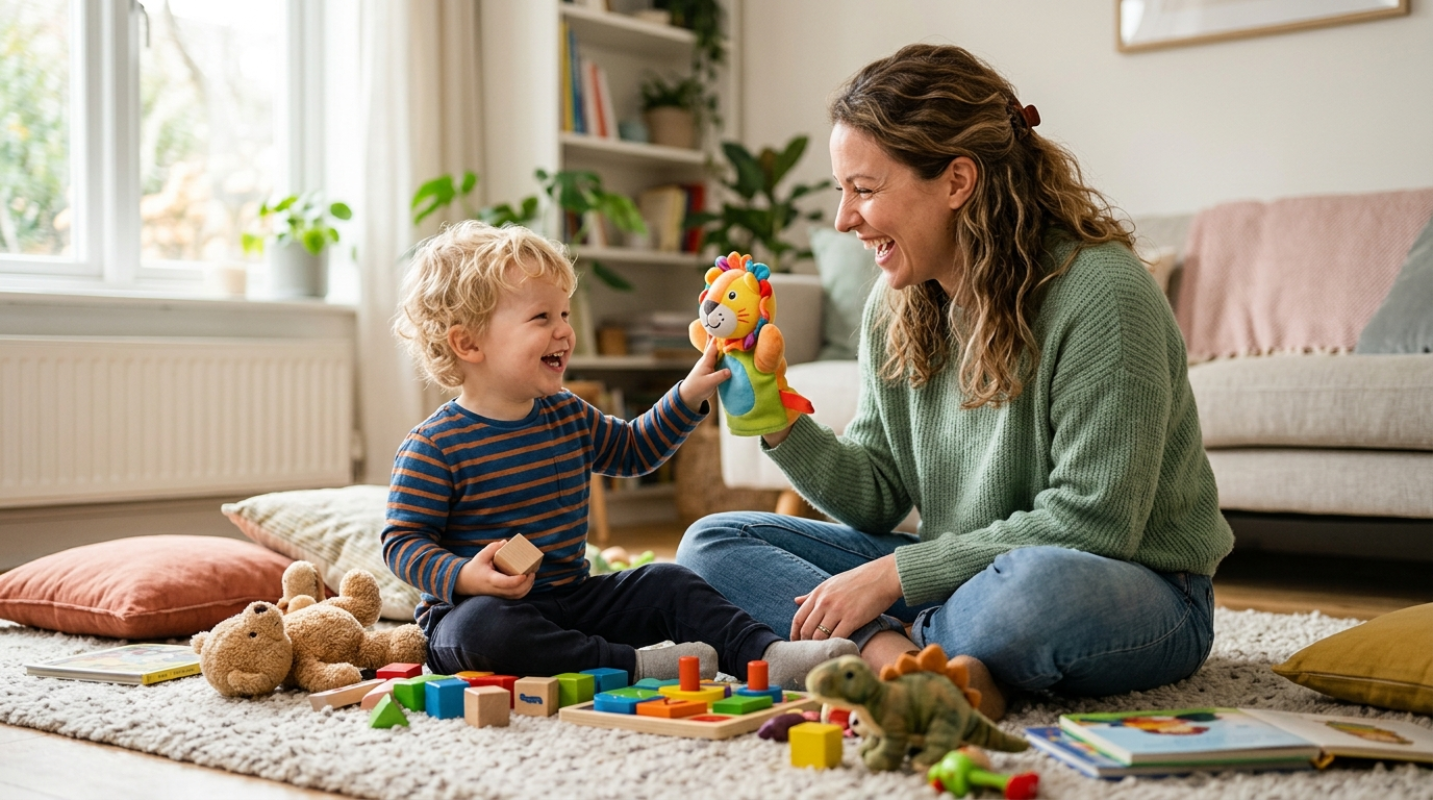
• Bring Emotions to Life: Toddlers find it easier to talk about feelings through a third party because of symbolic distance. Use a stuffed animal to act out a big feeling. Let the teddy bear have a silly tantrum because he does not want to take a bath, and let your toddler help soothe the bear.
• Dial Intensity Up and Down: Use physical play to match their high energy, and then playfully guide them back to calm. This teaches their nervous system how to ride sensory waves.
• The Robot Power-Up Game: When your child is overstimulated or resisting a transition, have them lie down. Pretend they are a robot that needs to power up. Press gently on their feet, knees, and shoulders while making funny beep-boop sounds. Finish with a firm, loving squeeze to calm their nervous system.
• The Sock Monster: Put a sock on your hand and pretend it is a very weak, silly monster. Let your child easily push the monster over or snatch the sock away. Letting them "win" gives them a sense of control and releases pent-up stress through laughter.
• The Color Zones Art Project: Use colors to represent feelings: blue for sad, green for calm, yellow for frustrated, and red for angry. Draw funny faces with your child on colored paper. When they start getting upset, you can say, "I think I am sliding into the yellow zone! Should we take three deep breaths to get back to green?"
• Roughhousing: Early childhood experts emphasize that physical play is an excellent way to release anxiety.⁵ Chasing games, pillow fights, or gentle wrestling help kids burn off physical tension and learn boundaries.
Here are some of the best resources and tools to help you bring playful parenting into your daily routine.
Building Long-Term Resilience with Consistency
Using play does not mean you stop enforcing rules. You can keep your boundaries firm while keeping the interaction light. If your child is throwing blocks, the boundary is still that throwing blocks is not safe. But instead of yelling, you can playfully fly the blocks back into their basket like rocket ships.
Your own self-regulation is the foundation of this entire approach. You cannot co-regulate with a child if you are screaming too. If you feel your own anger rising, take a deep breath before you react.
Try to view meltdowns as opportunities for learning rather than failures. Every time you respond to a tantrum with play and connection, you are helping your child build neural pathways for emotional control. It takes time, but consistency pays off.
Embracing the Messy Joyful Journey
Moving toward playful parenting is a shift in how you view your relationship with your child. It moves you away from constant correction and toward genuine connection.
You do not have to be a perfect, high-energy entertainer all day long. Even small, playful moments can make a massive difference in how your toddler handles their feelings.
Try just one playful technique today. The next time you feel a power struggle starting, put a cup on your head, make a silly face, or narrate your frustration. You might be surprised by how quickly the tension melts away.
Sources:
1. Zero to Three: Toddler Tantrums 101
https://www.zerotothree.org/resource/toddler-tantrums-101-why-they-happen-and-what-you-can-do/
2. We Are Families Rising: Playful Parenting Builds Better Brains
https://wearefamiliesrising.org/resource/playful-parenting-builds-better-brains-10-tools-for-success/
3. YouTube: Emma Hubbard on Toddler Meltdowns
https://www.youtube.com/watch?v=cAPCDazvekA
4. Max Mednik: Notes on The Way of Play
https://www.maxmednik.com/blog/notes-on-the-way-of-play-by-tina-payne-bryson-and-georgie-wisen-vincent
5. The Alliance for Early Childhood: Playful Parenting and Roughhousing
https://theallianceforec.org/blog/2024/9/9/playful-parenting-why-roughhousing-is-key-for-kids-growth
*This article on forhelps.com is for informational and educational purposes only. Readers are encouraged to consult qualified professionals and verify details with official sources before making decisions. This content does not constitute professional advice.*