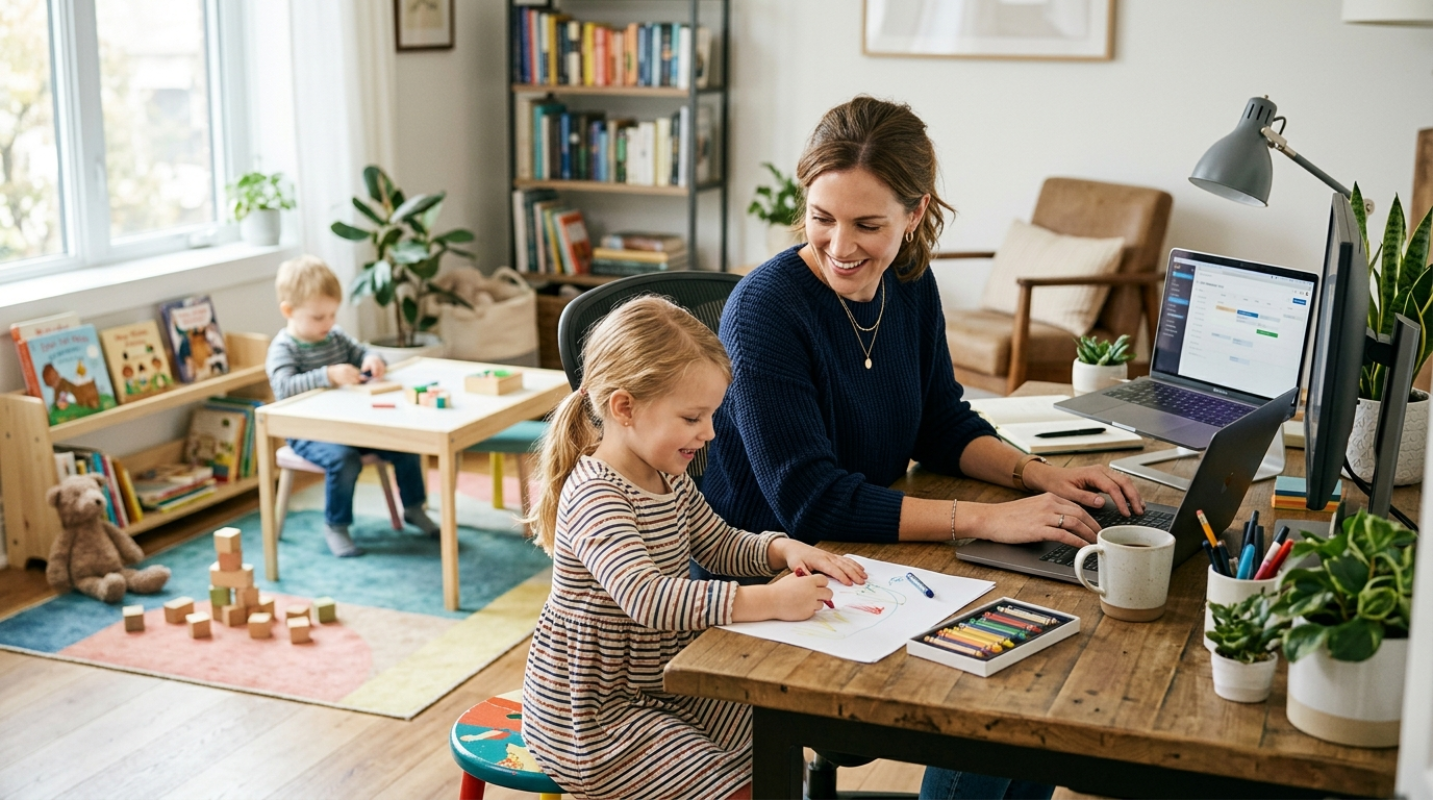
Did you know that remote work is literally changing the population? A landmark study from August 2025 showed that remote and hybrid work led to about 80,000 extra births every year in the US between 2021 and 2025.¹ When both partners work from home at least one day a week, their lifetime fertility increases by an average of 0.2 children.²
It turns out that flexibility makes starting or growing a family feel much more doable.
But let's be honest. It also means your workday is probably filled with the sounds of tiny feet, sudden arguments over toys, and the constant demand for snacks. Have you been there?
The old idea of a perfect work-life balance is dead. Now, it's all about work-life integration. You need a workspace that respects your career goals while keeping you connected to your family. Here is how to design a home office that actually works when your kids are home too.
Choosing the Right Location for Your Home Office with Kids at Home
Where should you set up camp? Finding the right spot is a balancing act between visibility and privacy.
If your kids are very young, isolating yourself behind a closed door on another floor is a recipe for anxiety. You'll constantly wonder what they're doing.
Instead, think about zoning your space. If you're working in a multi-purpose room like a living room or a large den, you can use modular furniture or tall bookcases to create physical boundaries.
The key is desk placement. Never set up your desk facing the wall with your back to the room.
Instead, use the Zoom Angle. Position your desk so you face the room, or at a 90-degree angle to it.
This setup lets you keep an eye on your kids in your peripheral vision. Best of all, it keeps their play area completely out of your webcam's field of view during professional video calls.
The Ultimate Kid-Friendly Home Office Setup
Sharing an office doesn't mean you have to surrender your professional aesthetic. You can create a family-friendly setup that accommodates everyone.
Start by setting up a mini-office for your kids. Children love to mimic their parents.
Give them a small, child-sized desk or a low-height project table in the center of the room. This becomes a screen-free zone where they can create, color, or read.
You can even paint a vintage school desk in a bright color, like hot pink or bright blue, to give them a sense of ownership over their workspace. Add a cozy reading nook with a couple of comfortable bean bags for quiet reading time.
Safety is your top priority here. Make sure to anchor all heavy furniture, like bookshelves and filing cabinets, to the wall. Keep electrical cords entirely out of reach by using under-desk trays and cable organizers.
What about the noise? A study by the University of Sydney notes that over 50 percent of people struggle to concentrate in noisy environments. Once you're distracted, it takes an average of 20 minutes to refocus.
Silence is hard to come by with kids, but you can use smart acoustic design to dampen the noise. No complicated renovations required.
• Acoustic panels: Install acoustic wood slat panels on your walls. These panels feature natural wood veneer mounted on a soft felt backing made from recycled plastic bottles, which absorbs high-frequency sounds like children's voices.
• Solid doors: Replace your cheap, hollow-core office door with a solid-core wood door. This is the single most effective structural upgrade you can make to block sound.
• Layered fabrics: Put down a thick area rug over a dense rug pad underlayment to absorb footsteps. Hang heavy drapes that weigh at least three pounds per panel to block sound leaks.
• Sound masking: Use an office white noise system to create an invisible acoustic barrier that masks sudden household noises.
To get your family office up and running, here are a few needed tools to consider.
Smart Storage and Clutter Control
When your office doubles as a playroom, clutter can quickly take over. You need a system that keeps your professional items safe and your kids' toys organized.
Keep all your important documents, electronics, and office supplies in high-reach storage. Floating shelves and tall cabinets are perfect for keeping sensitive work items far out of reach of curious hands.
For the kids, use portable supply baskets or plastic caddies. Fill these baskets with books, coloring pages, and quiet activities.
Try rotating these activity bins. Only bring out one or two at a time, then swap them out the next week to keep the activities feeling fresh and exciting.
Finally, establish a clean slate policy. At the end of every single workday, spend five minutes putting everything back in its place.
Clearing the physical clutter helps your brain transition out of work mode. It signals that the workday is officially over.
Establishing Boundaries and Routines
Even the best office design won't work without clear boundaries. Since kids are highly visual, you can use design cues to help them understand when you're available.
Try using a simple stop-and-go sign on your door or desk. A red sign means "do not disturb unless it's an emergency," while a green sign means "come on in."
You can also teach them that when you have your large headphones on, you're in a meeting and cannot be interrupted.
According to the KPMG Working Parents Survey, 53 percent of working parents struggle with ongoing childcare arrangements, and 50 percent actively seek more flexible schedules to reduce burnout.³ You can design your daily schedule to match your office layout.
Plan your high-focus tasks, like writing or deep analysis, during your kids' quiet time or nap time. Save low-focus tasks, like answering emails or organizing files, for times when they are playing nearby in the room.
When you need to transition from professional mode to parent mode, create a physical ritual. Close your laptop, turn off your office light, and walk away.
This simple routine helps you leave work behind so you can be fully present with your kids.
Designing a Space That Grows With Your Family
Your home office is not a static environment. As your kids grow from toddlers to teenagers, their needs will change, and your workspace should adapt right along with them.
The low-height create table that once held coloring books can eventually be replaced with an adjustable-height study desk. The toy bins can transition into storage for school textbooks and laptop chargers.
Designing a functional home office means building a space that embraces the reality of your life, rather than trying to recreate a sterile corporate cubicle.
By setting clear visual boundaries, investing in sound-dampening decor, and giving your kids their own dedicated workspace, you can protect your productivity without missing out on the daily joys of parenthood.
You don't have to choose between being a great professional and a present parent. With a little intentional design, you can easily do both.
Sources:
1. Extra Births Align With Work From Home Stanford Study
https://www.businessinsider.com/extra-births-align-with-work-from-home-stanford-study-2025-10
2. Work From Home Have More Kids
https://reason.com/2025/12/28/work-from-home-have-more-kids/
3. KPMG Working Parents Survey 2025
https://kpmg.com/us/en/media/news/kpmg-working-parents-survey-2025.html